Important Progress in Fundamental Research on Tellurium Embrittlement
Recently, the State Key Laboratory of Thorium Energy at the Shanghai Institute of Applied Physics, Chinese Academy of Sciences, made important progress in fundamental research on tellurium embrittlement in alloys. The related work, entitled "In-situ grain boundary alloying in Ni coatings: a strategy to suppress tellurium segregation and embrittlement", was published in Journal of Materials Science & Technology, an authoritative journal in the field of materials science. The first author of the paper is Fu Xin, a doctoral student at the Shanghai Institute of Applied Physics; Wang Kai is the co-first author; and the corresponding authors are Professor Jiang Li and Professor Li Zhijun.
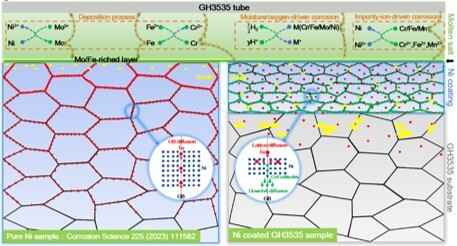
After long-term service, primary-loop metallic components in liquid molten-salt reactors face the risk that the fission product tellurium may diffuse along grain boundaries, weaken the grain boundaries, and eventually cause surface intergranular cracking. This problem threatens the service life and safety of in-reactor components, especially thin-walled components. In this study, pure nickel was electroplated onto the surface of GH3535 alloy and then subjected to corrosion in tellurium-containing molten salt. The researchers found that tellurium transport in the pure nickel coating changed from the expected grain-boundary diffusion to lattice diffusion. Subsequent tensile tests showed that the pure nickel coating maintained good integrity, and its cracking degree was significantly lower than that of the uncoated control sample. Theoretical calculations indicate that, during corrosion, alloying elements from the GH3535 alloy substrate occupy sites at the grain boundaries of the pure nickel coating through gradient diffusion, thereby suppressing the grain-boundary distribution and diffusion of tellurium. Based on these findings, the research team proposed a new strategy against tellurium embrittlement, termed "grain boundary alloying," which provides theoretical guidance for subsequent alloy composition optimization and process development.